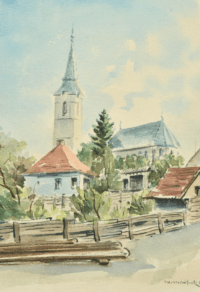
Walter Maisak
Walter Maisak (born January 10, 1912, in Böckingen; died January 10, 2002) was a German artist. He was born as the only child of piano carpenter Karl Maisak and his wife Emma (née Schaal) in Böckingen, now a district of Heilbronn. His mother passed away in 1914, and his father died at the front in 1916 during World War I. Maisak was raised by his grandfather and his aunt Karoline Maisak, who encouraged his artistic talents.
After completing secondary school, Maisak trained as a sign and decorative painter starting in 1927, while attending evening drawing classes. In 1929, he began his studies at the School of Applied Arts in Stuttgart, later transferring to the Stuttgart Academy of Fine Arts, where he received awards for works like “Street Workers” and “Parade.” Under Anton Kolig, he completed his studies as a master pupil in 1937 and subsequently worked as a freelance artist in Heilbronn.
In 1940, Maisak was drafted into the Wehrmacht, serving primarily as a draftsman. During his time as a Soviet prisoner of war, he was able to use his artistic skills to paint murals in kindergartens, which spared him from heavy labor in the lead mines. In 1949, he returned to Heilbronn and resumed his artistic career, remaining dedicated to figurative art influenced by late Impressionism, Expressionism, and New Objectivity. He completed over 100 public art projects and produced a series of evocative drawings reflecting his experiences of war and captivity.
Maisak passed away on his 90th birthday in 2002 and was buried in Böckingen. His artistic legacy has been preserved since 2016 at the Walter Maisak Archive in Heilbronn.
Showing the single result
-
Dorfszene, 1944 | Aquarell von Walter Maisak
Walter Maisak (1912-2002)