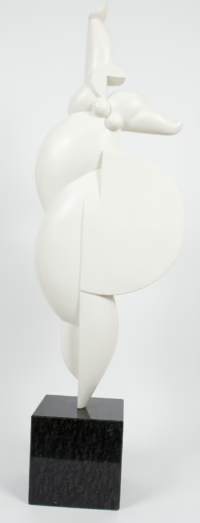
Christian Peschke
Christian Peschke (18 December 1946 – 1 July 2017) was a renowned German sculptor and painter whose work was characterized by a unique fusion of realistic and surrealist forms. As a representative of the contemporary artists of classical modernism, he mainly devoted himself to people in his works, whether in sculpture, painting or in “art in architecture” projects. Peschke maintained close artistic relationships with Salvador Dalí, Arno Breker and Ernst Fuchs until their deaths.
Curriculum vitae and artistic work:
Christian Peschke spent his childhood in Säckingen as well as in Spain, France and Stuttgart. He received a special permit at the age of twelve and was admitted to the State Academy of Fine Arts in Stuttgart. There he was taught by art professor Gerhard Gollwitzer and received important impulses for his artistic work. After training as a painter and varnisher, Peschke began to devote himself to both sculpture and painting. His works included large sculptures as well as smaller objects made of precious metals, jewelry and medallic art. He later continued his training at the Blocherer School of Interior and Communication Design in Munich before working as a creative director in a commercial enterprise. From 1982, he lived and worked as a freelance artist in Spain, where his works were influenced by the southern sun. Peschke undertook study trips through Western Europe, particularly to Italy and France, where he lived and worked for a time.
Works of art and style:
Peschke’s work is characterized by a rich variety of forms in sculpture, plastic art and painting, building on the foundation of the classical tradition of art. Particularly noteworthy is his depiction of harmony in the female body, emphasizing the mental and physical strength of women and elevating them to the pedestal they deserve. His works radiate beauty without being pathetic, and are characterized by rounded fullness and wholeness. In Peschke’s art, the female body is celebrated and seen as an homage to life. Art historians often regard Peschke as the European counterpart to the Latin American artist Fernando Botero, who is also known for his exaggerated proportions.
Peschke House:
The Peschke House in Flintsbach am Inn (Rosenheim district) was built specifically for the presentation of Peschke’s works in temporary exhibitions. The modern new building, designed by Peschke and his wife Angelika Peschke, served as the artist’s studio and exhibition forum from 2015. It developed into a meeting place for European artists and art lovers and is intended to promote contemporary art.
Art in public space:
Peschke’s works are present in various public spaces, including the Museum of European Art in Nörvenich, where a permanent exhibition has been held since 2007. His notable works include the “Dance of the Stars”, a large-scale sculpture in Monaco, which was unveiled by Prince Rainier III in 2003, and “The Dancer”, a sculpture for the collection of Prince Albert II of Monaco, which was presented in 2005. Peschke has also created reliefs and works of art for buildings in Bavaria and South Tyrol.
Exhibitions:
Peschke’s works have been exhibited in renowned galleries and museums worldwide, including the Stadt-Museum Bruneck in South Tyrol (2006/2007), the US Museum of European Art in Clarence, New York (2008), the Rittersaal in Nörvenich Castle (2010) and the Palais im Großen Garten in Dresden (2010). In 2012, he designed the George Tabori Prize in Berlin.
Christian Peschke’s career leaves a significant legacy in the contemporary art scene and his works continue to be appreciated and admired by art lovers worldwide.
Showing the single result
-
Tänzerin | Figur von Christian Peschke
Christian Peschke (1946 – 2017)